4 questions to
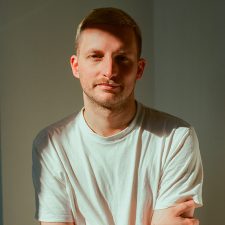
Gabriele Spalluto
1
Your photographs of the Swiss border show constructions, but you have excluded any human presence from the border posts. Why?
My research for « Hic Sunt Leones » began with the architecture of places. People and their stories tied to the border are a vast and certainly interesting topic; however, I decided to focus on something more specific. I asked myself what is the first thing you see when entering Switzerland and what value it might have. Architecture is not neutral; it represents something, and my research aims to explore this point—in a fairly neutral and aesthetically detached manner. Customs posts are a highly symbolic place in themselves; what do these prefabricated buildings and these often anonymous constructions communicate to us? The research is thorough and reveals similarities and differences.
2
Switzerland has a diverse identity: a small territory with four languages and distinct cultures. When photographing thresholds, the entrances and exits of the country, did you notice things in common between the regions?
It’s true, Switzerland has four languages and four cultures, but in some areas these differences are less visible. Paradoxically, customs aren’t that different across Switzerland’s various regions. Of course, there are significant differences when considered individually, but for example, many customs posts share some common features, depending on where they are located. The sheet metal used, the font used to write the name of a place, the flag, and other small details are consistent and the same throughout Switzerland. There are also individual places and buildings that are extremely distinctive, and in general, some more interesting structures are found in cities or large towns. If we consider the topic of borders in a broader sense, the differences are much more stark: in some regions, such as Ticino, where I come from, it is a daily topic with tangible and very present effects, while in large parts of Switzerland (such as Zurich), it is a much less deeply felt and intimate issue. The book therefore aims to spark a discussion on this issue.
3
You preserved 175 images taken from the same angle. Could you explain the motivation for this choice ?
Aesthetically, I’m a lover of minimalism and neutrality. My photographic language is often very discreet and unobtrusive; I prefer to work more quietly, creating very precise and aesthetically neutral images, thus providing viewers with a fairly broad scope for interpretation. Serial work is important to me, and in the research for « Hic Sunt Leones », it was necessary for me to carry it out rigorously, eliminating as many variables as possible until arriving at a series of images that, on the one hand, constitute a corpus and, on the other, are comparable. The aesthetic choices are made to place the architecture of these (non)places at the center, and the perspective I chose subtly engages with the project’s title. We see the last few meters of Swiss soil and then, increasingly smaller due to the perspective, the first meters of what lies beyond.
4
At first glance, your images appear to be postcards of Switzerland, yet they convey a political message: they both welcome and monitor crossings. Is this a certain malaise that you have sought to provoke?
Customs posts are certainly ambivalent places. Formally, they are places of defense, they are guarded, photography is prohibited, and numerous checks are carried out there…
But if you think about it, they are also the first bastion of a state, the first thing anyone sees of a new nation; we could say they can also act as a kind of calling card. Switzerland is landlocked, completely surrounded by other nations, and is not part of the EU, so it has numerous customs posts on all sides of the territory. These places carry—or perhaps it’s better to say carried—many stories: in every customs post there were officials, and often the buildings also included their homes. All these places were manned, but at the same time also lived in. With the advent of the Schengen Area, the situation has changed; manned crossings are few and far between, and border control in general has changed form.
With my project, I wanted to explore the symbolic value of these places and how their architecture might influence it: if I arrive at a large highway crossing crowded with police and cars, I realize something is about to happen. What if I’m on top of a mountain and the only thing marking the border between two states is a boundary stone and a flag? Symbolically, these are two diametrically opposed experiences; on a practical level, however, the same thing is happening. On the one hand, one state appears strong and present; on the other, it offers us a bizarre postcard. My only stance is the book’s title, « Hic Sunt Leones », which harks back to a legend on some Roman maps.
The Romans wrote it when they didn’t know what laid beyond, to draw attention; we know very well what lies beyond the border, and there are certainly no lions or dangers there, yet for some politicians, it’s becoming increasingly important to close them off or monitor them extensively. What I wanted to show in my project is the clash that arises between the intentions of some and the reality on the ground, where often the only defense there is on the border is a stone or a flag.